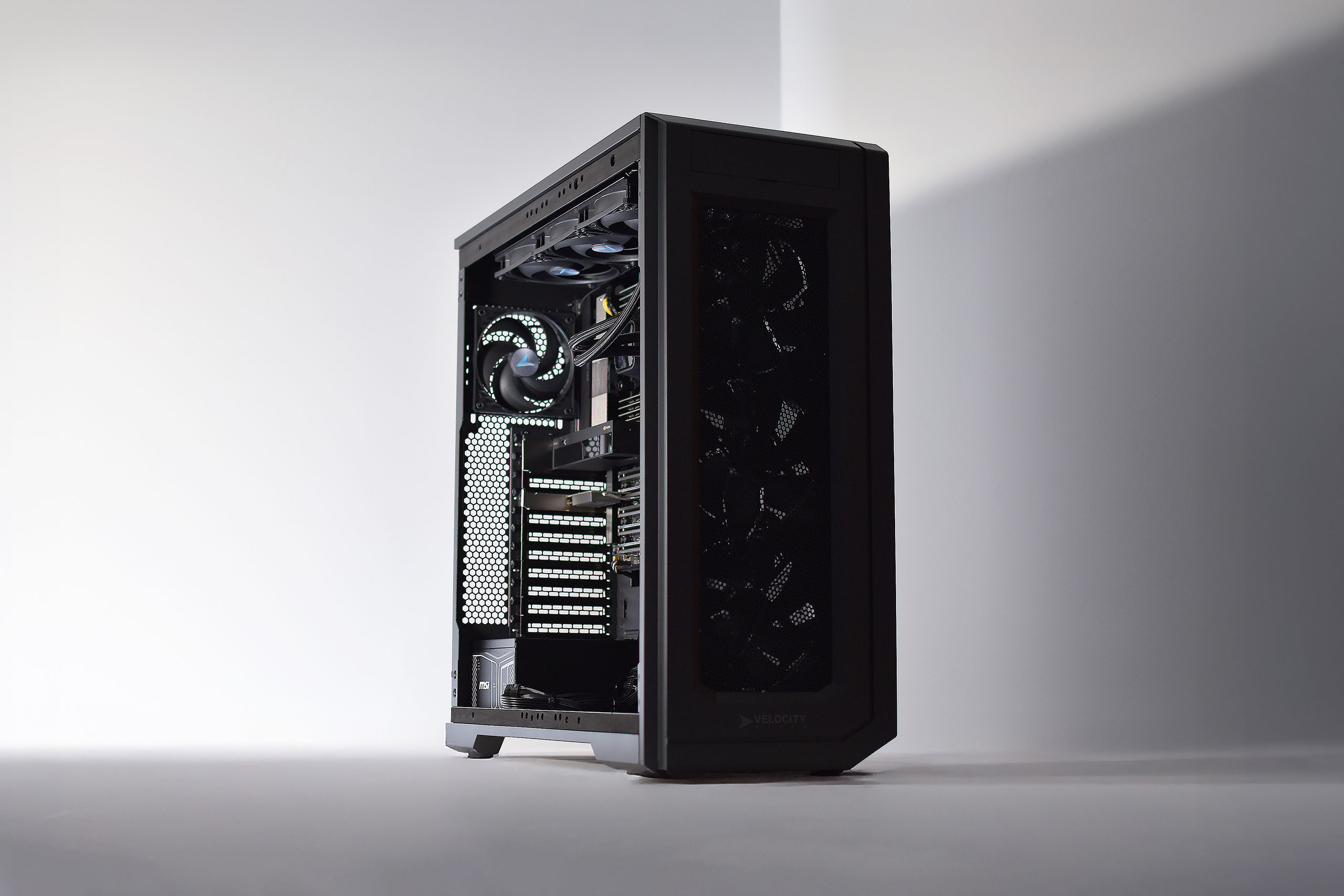
Before we sing the praises of EPYC PC workstations, let’s take a quick step back. Oftentimes, the title of “workstation” is donned upon a computer for the programs it runs rather than the contents of its case. For some, it could be a beefed-up desktop processor, a professional-grade GPU, and some ECC memory. However, the explosion of artificial intelligence, complex computational fluid dynamics (CFD), and large-scale 3D rendering has pushed traditional hardware to its limits. To keep up with these massive data pipelines, professionals are increasingly turning to server-grade infrastructure packed into a workstation chassis.
At the forefront of this shift is the AMD EPYC processor. While Intel’s Xeon and AMD’s own Threadripper Pro have long been the go-to solutions for heavy enterprise workloads, EPYC PC workstations offer a distinct set of advantages in memory bandwidth, core density, and multi-GPU scalability that leave the competition in the dust.
Here is a closer look at the specific benefits an EPYC workstation can offer your pipeline.
AMD EPYC PCs: Dominating Core Density and Efficiency
When squaring off against Intel Xeon workstations (such as the Xeon W-3400 series), AMD EPYC dominates in raw scale and parallel processing capabilities.
-
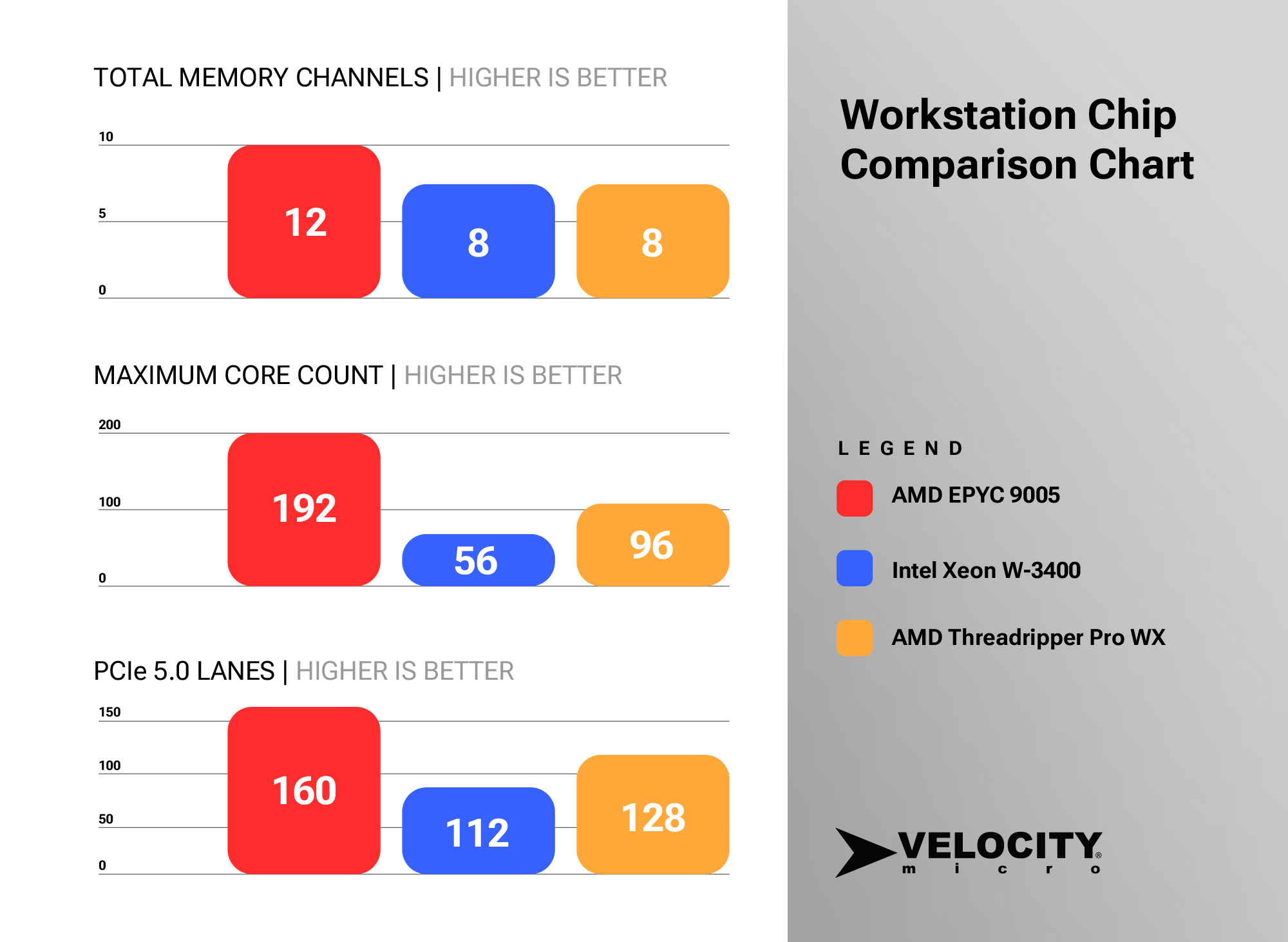
Unmatched Core Density: AMD’s latest EPYC processors (like the 9005 Turin series) boast up to a staggering 192 cores and 384 threads per socket. By comparison, Intel’s highest-end workstation and server offerings consistently trail behind in raw core count. For workloads that scale linearly with cores, such as CPU-based rendering or large-scale virtualization, EPYC handles massively parallel operations with significantly less bottlenecking.
-
Superior PCIe Lane Availability: Modern workloads often require massive I/O pipelines to feed NVMe storage arrays and multi-GPU setups. EPYC processors offer up to 160 PCIe 5.0 lanes (in single or dual-socket configurations). By contrast, Intel’s flagship W-3400 workstation CPUs cap out at 112 PCIe 5.0 lanes. This massive I/O advantage means EPYC users don’t have to compromise on bandwidth when running multiple high-end AI accelerators or network cards.
-
Power Efficiency: Built on advanced chiplet architecture (Zen 4/Zen 5) and smaller manufacturing nodes, EPYC processors provide incredibly high performance-per-watt. In sustained, compute-heavy server/workstation workloads, EPYC uses less energy for equivalent or superior performance, making it highly cost-effective over its lifecycle.
AMD EPYC vs. Threadripper Pro: Server-Grade Scale at the Desk
AMD’s Threadripper Pro is arguably the best traditional workstation processor on the market, offering incredible single-core boost clocks for interactive 3D modeling and engineering software. However, when the workload transitions from content creation to massive computation and data processing, EPYC clearly takes the lead.
-
Massive Memory Bandwidth and Capacity: The memory controller is where EPYC truly separates itself. Threadripper Pro (9000 WX-Series) features an impressive 8-channel DDR5 memory architecture supporting up to 2TB of RAM. EPYC, however, is a true server platform. It features a 12-channel DDR5 memory architecture, delivering 50% more bandwidth (up to 576 GB/s) and supporting up to a massive 6TB of RAM per socket. For memory-bound tasks like training large language models (LLMs) or genomics sequencing, EPYC keeps the GPU pipelines fed where Threadripper Pro might bottleneck.
-
Dual-Socket Scalability: Threadripper Pro is strictly a single-socket platform. EPYC motherboards are built to scale. You can configure a dual-socket EPYC PC workstation to wield massive core counts (up to 384 physical cores and 24 memory channels in a single system), offering computing density that Threadripper Pro physically cannot match.
-
4-to-8 GPU Configurations: While Threadripper Pro’s 128 PCIe 5.0 lanes can technically support four GPUs, the WRX90 motherboard ecosystem is heavily restrictive for full 4+ GPU setups. EPYC platforms are native to high-density accelerator layouts. If you are building a deep learning workstation with 4 to 8 GPUs, EPYC is the required platform to ensure that PCIe lane sharing does not cripple your bandwidth.
Is an EPYC PC the Right Choice for You?
If your daily workflow relies on high-frequency, single-threaded responsiveness (like active CAD design or interactive VFX workspaces), Threadripper Pro or a high-clocked Intel CPU remains a stellar choice. But if you are building an AI training node, processing massive datasets, or rendering complex fluid dynamics, you need the unrestricted memory bandwidth, high PCIe lane counts, and core density of AMD EPYC.
For organizations ready to bring data-center-level power directly into the office environment, deploying an enterprise-ready system is a must. The Velocity Micro ProMagix HD360A EPYC PC Workstation is a phenomenal option, expertly engineered to leverage EPYC’s incredible parallel performance, massive memory limits, and robust PCIe arrays inside a reliable, quiet, and premium chassis.

Latest posts by Marcus Nicolois (see all)
- AMD EPYC PC Workstations: Best of the Bunch? - May 19, 2026
- Why gaming on battery sucks, but not for long - March 10, 2026
- Why We STILL Build PCs in the USA - May 22, 2025
The shift toward server-grade infrastructure in workstation chassis is undeniable, especially given how core density impacts linear workloads like CPU-based rendering. Highlighting the 192-core limit of the newer EPYC series really drives home why memory bandwidth and multi-GPU scalability are becoming the defining factors for modern data pipelines.
This was a great read! I always thought Threadripper Pro was the top choice for workstations, but the memory bandwidth numbers for EPYC really surprised me. 576 GB/s is huge. Makes sense why it’s better for AI training and big datasets. Thanks for breaking it down so clearly!